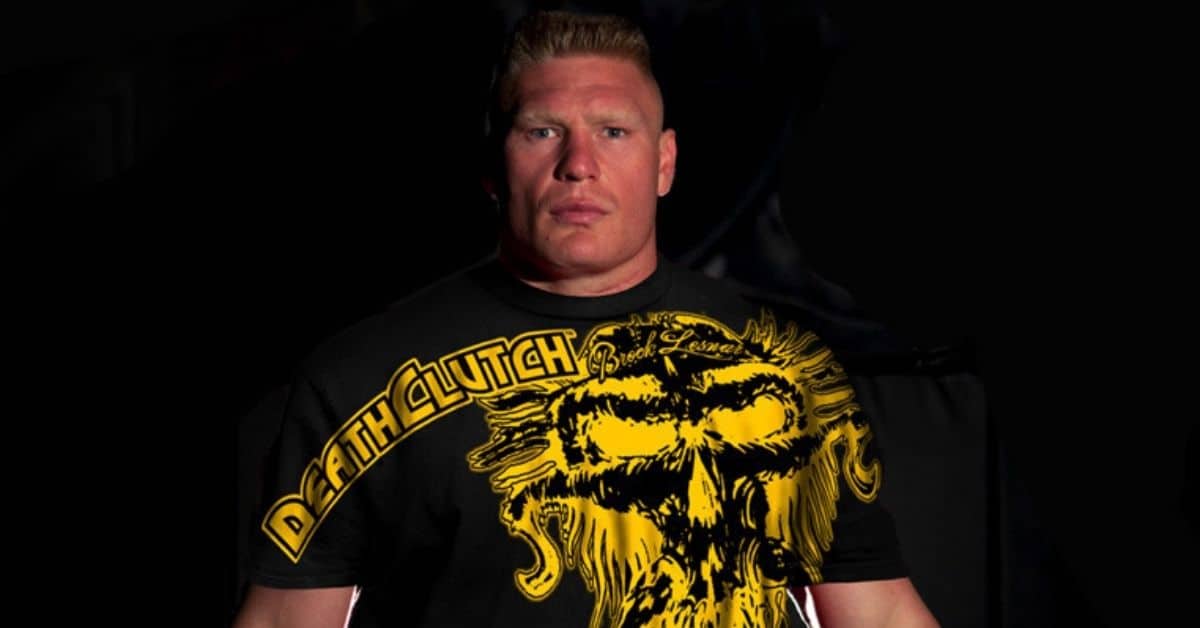
Exclusive Interview: Brock Lesnar Discusses ‘Death Clutch’
“The bottom line: I don’t talk about my personal life with strangers. This one time, and this one time only. You are invited to join me in my private world for a few hours. Just don’t ever expect another invitation.” – Death Clutch: My Story of Determination, Domination, and Survival, Brock Lesnar’s autobiography
By Brian J. D’Souza
Harper Collins provided me with an opportunity that comes too infrequently in MMA — a chance to talk to Brock Lesnar one-on-one, to discuss his new book, while he’s in a good mood. The truth about Lesnar? He came from a small town, worked extremely hard, and utilized a wrestling persona to become the number one MMA draw. Does he hate the media? How much money does he make? And what does he think of promoters like Vince McMahon who pull all the strings? Read our three-part interview series with the controversial UFC heavyweight contender and find out…
BRIAN D’SOUZA: Death Clutch is your story, it’s your autobiography, it’s written in conjunction with Paul Heyman. First of all, tell us a little bit about your relationship with Paul, when you first met him?
I met Paul back in 2001, working for the WWE, and Paul was working as a writer for Vince McMahon, and I met Paul one day, he came up, and introduced himself. The next thing I knew, we were working together, and he was my onscreen manager and we became friends throughout the process, and stayed in contact over the years, and it was a delightful process for him and I to get together and reminisce and put this book together.
So of course, he had a lot of writing experience. I noticed the book is well-written.
Yeah, the main reason I decided to do this with Paul is because I felt comfortable having a conversation with him about all the subjects. Between him, the publisher, and my attorneys, I believe it’s a well-written book.
Can you tell me a little about your relationship with Erik Paulson, one of your trainers?
Erik is a Minnesota guy, and I met Erik through Greg Nelson. Greg was one of the first guys that started training me for Mixed Martial Arts and throughout the process, I was able to meet Erik Paulson; being fellow Minnesotans and Erik having a plethora of knowledge in the sport he’s been a mentor of mine throughout the full process.
I heard a rumor — maybe true, maybe not — that before the Shane Carwin fight you stopped working with him and concentrated on other trainers. Is that true?
Well no, I’ve cycled a lot of different people through. At one time, I brought Peter Welch in. I’ve never really quit working with anybody. I just didn’t have the opportunities or enough time throughout my weeks when I needed to fit people in and all these guys, [I] kept an open relationship with all these people. I’ve used them for one day in a training camp, or an entire training camp. Sometimes our schedules — because they’re off doing seminars, or what not — sometimes our schedules never work out. But these guys — I attribute a lot of my success to being coached by these guys.
What’s your philosophy in sparring? Do you go all-out, or do you go very light like they do in Thailand to preserve themselves?
To get the general feel — there’s days when we have [light] sparring, and there’s days when we have full-out sparring. For me to get the feel, there’s days when we’re going full-out, and I think you have to, because if you don’t gain the experience in the training room, you can’t have it in the octagon.
Going back to the book, you talk about the influence of your parents putting you in many sports, like many parents do here in Canada, here in North America. What do you think the psychological effect of not hearing a lot of praise was? Did it affect you a little bit?
Well no, there was a lot of positive energy around me. My mom — it might have come across in the book where all my mom wanted me to do was win, but it was an energy she wanted me to understand that I’m in this to win this. Both my mom and dad were very supportive. My mom just didn’t want to hear any whining if I lost.
I can see that. We do have something in Canada like hockey parents or soccer parents — I can only draw on my own experiences — not everyone’s a natural athlete or very gifted, as you obviously were. Psychologically, sometimes people have different talents, too. It’s pretty common, don’t you think?
Oh, absolutely. They want their children to succeed, but I believe there’s a thing of over-coaching and over-parenting. You can’t force anybody to do anything, and me being a parent, I understand that very well. If my children don’t want to participate in an activity, I don’t think it’s right for me to force them to do anything.
It can be a problem with some coaches, too. Early on, some would threaten me — some couldn’t make it themselves — even to the point of [threatening] physical violence. That can be very uncomfortable. In wrestling circles, there’s [high school] players who’ve died, football players who’ve died of dehydration, wrestlers who’ve died of dehydration. It’s completely unnecessary in my opinion.
There are coaches out there that shouldn’t be coaches. And there’s parents out there that shouldn’t be parents. But what are you going to do about it? Nothing.
Moving on, you went to Lassen Community college [in California] and you mention not having a lot of money, having to struggle a lot. Where did you stay? I don’t think that that’s completely explained [in the book], to pick up a couple credits.
I stayed with the wrestling coach there. He was kind enough to rent me a room in his house there for little or nothing, and that was an experience that I’ll never forget: driving out to California to a junior college [when] at the time I had never been out of South Dakota or Minnesota or North Dakota, so it was quite the adventure for a young lad.
That’s exciting, because you leave home once, and you find yourself constantly leaving and jetting off to different places.
Yeah, unexpected places. It made life interesting, that’s for sure.
You talk a little about media attention. It starts off during your [college] wrestling career because you’re winning, you’re being successful, you talk about your dislike for it. Were you proud when you were profiled by GQ in 2010, in July?
Yeah. I guess I shouldn’t say that I really dislike the media, I don’t. It’s just that when it’s time for me to isolate myself and to stick to a job where it’s just me or a family man, I’ve been very private in those areas. Anytime that I have something to legitimately talk about, I’ve got no problem dealing with the media.
With your illness that cropped up before your Shane Carwin fight…you said you came close to feeling like — or thinking — you were going to die. What revelations did you have?
Here I was, I thought I was a healthy person, and I was laying in a hospital room, unsure of what my sickness was. And in a lot of pain, so a lot of things go through your mind, wondering what’s going to happen, what does the future lie and what direction is this going to take you.
There’s your stage persona, and there’s your own job and family. I understand you didn’t want the media to cut into time when you’re having dinner with your family.
I really don’t know anybody that does. My time with family is very important to me and in today’s age with the cell phone and the internet, there’s not a lot of privacy left in this world and everybody knows what everyone is doing at any given time and I don’t really care if anyone knows what I’m doing at any given time.
Moving on to your wrestling career, you talk about not having watched — what is it — five minutes of wrestling before you came to professional wrestling. Is that true?
That is true.
So what sports were you drawn to view, to watch, growing up?
Well growing up, we had 2 ½ TV channels that sometimes worked, and sometimes didn’t. And in the summertime, I very rarely watched any television because we were working. I was outside. To me, if I’m inside, I don’t feel natural. My sons are the same way — they’d rather be outside doing something and I think that that’s a big problem in today’s society where kids are in front of the computer, the television and the game boxes; they don’t get to go outside and experience communication, and nature, and get out and be creative and entertain yourself, and not having to be entertained by technology.
That’s a very valid point. But kids today are seen as consumers and the companies want to sell as much product as they can to them, and if that means forcing them to stay in this circle where the media starts exploiting them from the start…
I’m sure, but I think that’s where parenting has to come in and do certain things, but I can only control what’s happening in my household, and that’s fine with me.
Back to wrestling, you talk about Vince McMahon putting his guys on the road 300 days a year, through injuries, and eventually he gets a little bit of ownership over the wrestlers, is that correct?
These guys, they just don’t have another life. When they go home, they really can’t get out of tune with their on-stage persona. There’s really no time. I think the biggest thing is there’s really no downtime for the human body to recover, and more importantly, for their mind to recover where you’re constantly on the road, and in a program where you can’t get outside to take an outside look at what’s going on — guys resort to all kinds of extracurricular activities.
And by those, we’re talking about painkillers — because the injuries are constant and lagging — a lot of exploits, a lot of good times, but a lot of meaningless relationships, too.
Everything in general, whether it’s all the above, I’m sure there’s all kinds of that going on.
What kind of regulations were in place to protect the safety of wrestlers, or even [let you know] if you were being paid fairly? Was there anything like that?
No, none whatsoever. We were hired as independent contractors, and there was no players’ or wrestlers’ union or anything like that for us to even be involved in. And I chose to leave that career; most guys are happy with that career, and that’s fine. As long as they’re happy with their life — and I wasn’t, so that’s why I decided to make the move.
Sometimes we do see a bit of exploitation when regulations are not in place. In boxing, there were a lot of problems with corruption. Boxing was once a monopoly in the ’50s, sort of controlled by mafia-type gangsters, and they could even tell you what the outcome of fights would be…the government eventually had to step in. Do you think there should be a couple more laws in place to protect wrestlers almost from themselves?
At the end of the day, listen, these are grown men and women you’re talking about, and if they’re not responsible enough to take care of themselves like I was, or was able to do, I can’t point a finger at Vince McMahon or his company because they’re running a business, and they run it on capitalism and it’s good for them, but if the wrestler, and the individual can’t take care of it, then find a different occupation like I did.
A couple quotes here about Vince McMahon, one that I thought was really good, “Vince has ended more than one career when someone crossed him and put their own [interests] above the company.” You know, that’s the pro wrestling model. Do you have anymore details about what the politics were, exactly?
Like I said before, working for that company, you have to be a yes-man. You couldn’t write your own storyline; you were pushed by the writing team and the power of the pencil. So, as long as you were a good student, and the company thought that they could make a good amount of money off of you, then the writer and the pencil got behind you, whereas in the UFC, I’m in control of my own destiny. It’s just me and the other man in there, and when I win, it’s on my terms, and it’s not because somebody behind the curtain said that “you’re winning tonight.”
You were criticized very heavily when you entered the UFC — very heavily and very unfairly when you look at your wrestling credentials — for getting the title shot after beating Heath Herring, and then fighting Randy Couture. How did that make you feel?
It didn’t bother me at all. I had something to prove, and that was to be UFC heavyweight champion at the time. It just fueled the fighter within me, and it made me want to prove everybody wrong even more.