
The Nine Most Disappointing Debuts in UFC History
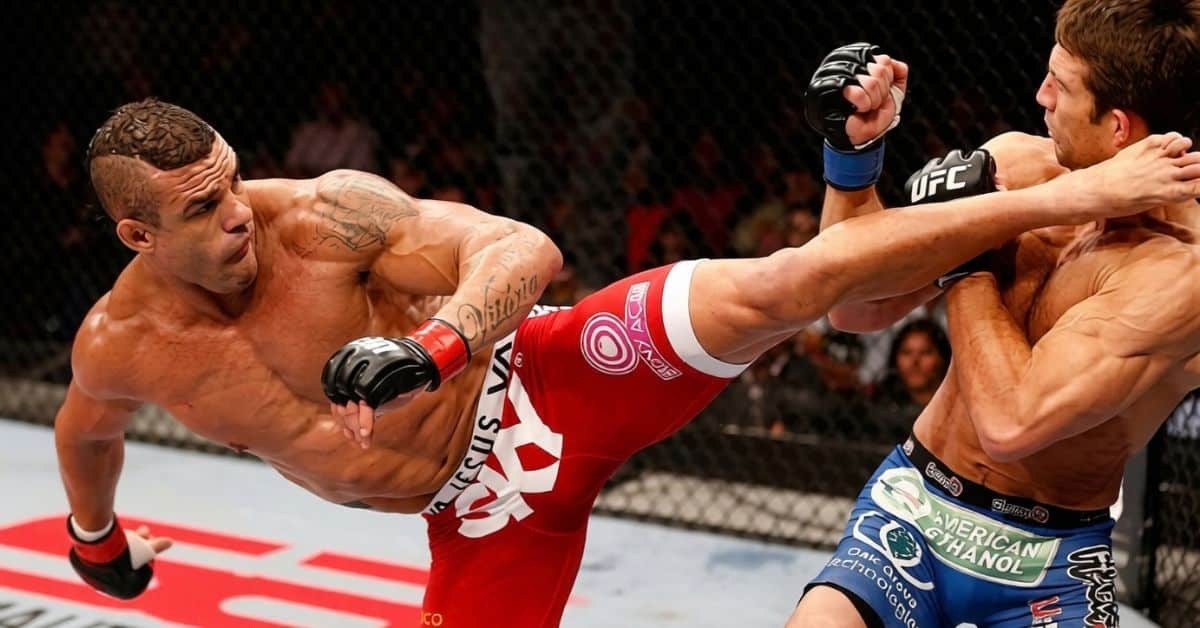
Tomorrow night in Georgia, former Strikeforce middleweight champion Luke Rockhold returns to the Octagon for the first time since having his face kicked into space by Vitor Belfort at UFC on FX 8 last May. Although Belfort was coming off a blistering head kick KO of Michael Bisping at UFC on FX 7, many were still picking and betting on Rockhold to defeat “The Phenom” in his UFC debut, and the betting line surprisingly closed as a pick ‘em.
Things didn’t go Rockhold’s way that night, to say the least. In hindsight it’s not such a bad loss considering what Belfort did to iron-chinned Dan Henderson in his next bout, but it was still incredibly disappointing for the highly-touted Californian to be knocked out in less than five minutes when — on paper at least — the fight with Belfort should have been much more competitive.
Of course, Rockhold isn’t the first UFC fighter who fell short of expectations in his Octagon debut. The question is, will he rebound in his second fight, or fall deeper into “bust” territory? Read on for our list of eight other fighters who didn’t live up to the hype in their first UFC appearances, and let us know if we’ve left out any notable disappointments.
Ben Rothwell
After the IFL collapsed, the promotion’s former heavyweight champion Ben Rothwell made his way over to the UFC and debuted against fast-rising contender Cain Velasquez at UFC 104. Although Rothwell’s aura of invincibility had been cracked by Andrei Arlovski’s limbs at Affliction: Banned the previous summer, there was still hope that he could get back to his winning ways and make a run for the UFC heavyweight title.
But against Velasquez, it was clear that Rothwell was thoroughly outclassed by a far superior mixed martial artist, and “Big Ben” suffered the second true knockout loss of his career. In hindsight, it’s not surprising that Rothwell couldn’t hang with Velasquez, the current UFC heavyweight champion, but at the time it was a harsh reality check for those hardcore MMA fans who believed in Rothwell after his IFL run.
Norifumi “KID” Yamamoto
For years, North American fans were hoping and praying for Norifumi “KID” Yamamoto to make his way over to the WEC and fight the other top bantamweights in the world. “KID” never fought in the WEC, but after the UFC swallowed up the promotion and transferred their fighters over to the Octagon, the Japanese superstar got his shot at the big show and took on Demetrious Johnson at UFC 126.
But although Yamamoto was a 2-to-1 favorite over Johnson, he was outwrestled by Johnson and ended up losing a very disappointing three-round decision. Yamamoto then followed that up with two more losses to Darren Uyenoyama and Vaughan Lee, and when you think about how bad he looked in all three bouts, it’s clear Yamamoto wasn’t the same guy who was knocking dudes out left, right and center in Japan. Not even close.
Anthony Pettis
Anthony Pettis had just won the last-ever WEC championship with his highlight-reel showtime kick against Benson Henderson at WEC 53 and had earned his way into a UFC title fight against the winner of UFC 125’s Frankie Edgar vs. Gray Maynard II. But when Edgar and Maynard fought to a draw, UFC president Dana White told Pettis to take another fight and at the TUF 13 Finale he took on veteran Clay Guida in a fight most expected him to dominate.
But despite Pettis’s flashy striking and Guida’s love of standing and banging with his opponents, “The Carpenter” was able to use a smart wrestling gameplan against Pettis, scoring takedowns and sitting in top control long enough to get the judges’ decision. It was a poor performance by Pettis and he had to win three more fights before he finally got his UFC title shot, but when finally got his crack at the belt he made the most of it, with a submission win over Benson Henderson at UFC 164.
Jake Shields
Jake Shields had won 14 fights in a row and was coming off a gigantic win over Dan Henderson to retain the Strikeforce middleweight championship when the UFC decided to sign him and put him on the fast track to a title shot. For his first fight, Shields would take on top contender Martin Kampmann at UFC 121, and the winner would earn a fight against UFC welterweight champion Georges St-Pierre.
Despite Shields being a sizeable favorite heading into the match, Kampmann and Shields grappled back-and-forth for 15 minutes, and at the end of three rounds it was tough to say who had won. Although many thought Kampmann did enough to secure the victory, Shields ended up getting his hand raised by split-decision. But while the fight went down as a win on his record, it didn’t help him win any fans in his Octagon debut, as his bout with Kampmann was a total snoozer — something that nearly all of Shields’s UFC fights have ended up being.
Uriah Hall
After knocking out Adam Cella with a spinning hook kick on The Ultimate Fighter — which UFC president Dana White hyped up as “the nastiest knockout in UFC history” — and having TUF coach Chael Sonnen label him an instant contender, the hopes were high for Uriah Hall to enter the UFC and immediately wreak havoc on the other 185-pounders fighting in the Octagon.
At the TUF 17 Finale, Hall officially stepped into the Octagon for the first time and across the cage staring at him was 21-year-old Kelvin Gastelum, who the betting public wasn’t even giving a chance to win, as Hall entered the fight as a 3-to-1 favorite. Yet despite the odds saying he didn’t have much of a chance, Gastelum was able to outwork the bigger, more experienced Hall over the course of three rounds and win a split-decision to earn the six-figure TUF contract.
It was an incredibly disappointing performance by Hall, made only worse by his follow-up effort against John Howard at UFC Fight Night 26, where he played patty cake with his opponent inside the Octagon and lost another split-decision. Sure, Hall recently TKO’d Chris Leben to get back in the win column, but it’s hard to forget how passive he looked in his first two UFC fights, and it’s very likely that White’s hype for him was just that all along — hype.
Rameau Thierry Sokoudjou
With back-to-back knockouts of Antonio Rogerio Nogueira and Ricardo Arona in PRIDE, the heat behind “The African Assassin” was at an all-time high when he made his UFC debut against Lyoto Machida at UFC 79. In fact, fans believed in Sokoudjou’s potential so much that he actually closed as the betting favorite over Machida, who was still undefeated at the time.
The fight turned out to one of the greatest hype-deflations in UFC history, as Sokoudjou ended up losing to Machida via second-round submission, and looked terrible in the process; he didn’t even come close to resembling the fighter he was in PRIDE. In the end, Sokoudjou was just a stepping stone for Machida’s run at the title, and the African Assassin was released from the UFC’s roster just two fights later.
Mauricio “Shogun” Rua
Mauricio “Shogun” Rua had ended his incredible run in PRIDE with a brutal KO victory over Alistair Overeem at PRIDE’s penultimate event, and for his first fight in the Octagon he was booked to face off against TUF 1 winner Forrest Griffin at UFC 76 in what most thought would be an easy win for Rua.
Yet, despite Rua entering the fight as a -300 favorite, the former PRIDE middleweight grand prix champion showed up to the bout out of shape. Absolutely exhausted in the third round, he gave up his back to Griffin and was submitted via rear-naked choke.
It was an shockingly bad performance by Rua, but he was able to turn things around quickly and just a few fights later he would KO Lyoto Machida to win the UFC light-heavyweight title. Still, Shogun’s fight with Griffin became infamous as one of the most disastrous debuts in UFC history for a fighter with Rua’s talent.
Hector Lombard
With a 25-fight unbeaten streak in tow, Hector Lombard hit the free agent market as the Bellator middleweight champion and was immediately courted by the UFC. Despite Bellator having matching rights to any deal Lombard was offered by Zuffa, they decided to decline when the UFC gave him a massively inflated deal that reportedly included a $400,000 signing bonus, a $300,000 base salary to show, plus those highly coveted pay-per-view points.
Lombard entered the Octagon at UFC 149 opposite Tim Boetsch, and the general assumption was that Lombard would destroy Boetsch then earn a title unification bout against Anderson Silva. But despite coming into the UFC with so much momentum, Lombard laid an egg and ended up losing a split-decision on the judges’ scorecards in what was a hugely disappointing effort for everyone involved.
Lombard has since dropped down to 170 and earned a big knockout win over Nate Marquardt in his welterweight debut, but it’s hard to forget how bad he looked against Boetsch at that dreaded UFC 149 event.