
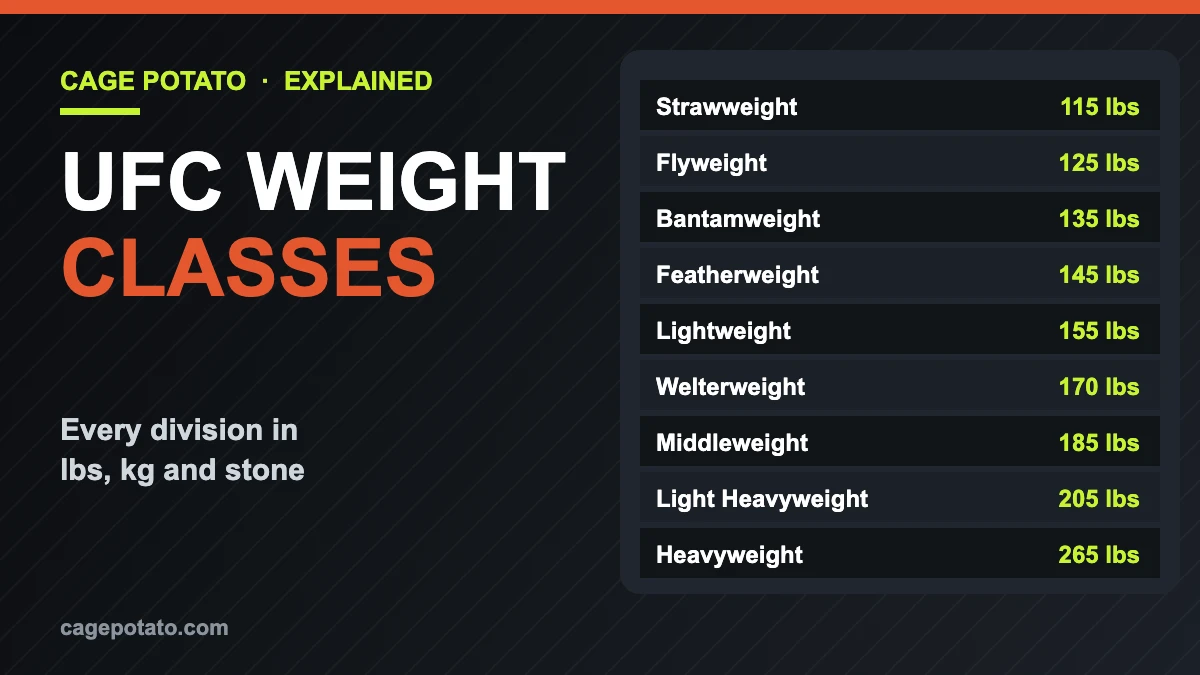
UFC Weight Classes Explained: Every Division in lbs, kg and Stone
The UFC splits its fighters into nine weight classes, from 115-pound strawweights up to 265-pound heavyweights. Some divisions are men-only, some are women-only and three are shared. Below is every UFC weight class with its limit in pounds, kilograms and stone, plus how weigh-ins work, what happens when a fighter misses weight and how the UFC divisions compare with the full Unified Rules list.
UFC weight classes at a glance
| Weight class | Limit (lbs) | Limit (kg) | Limit (stone) | Who competes | Non-title limit |
|---|---|---|---|---|---|
| Strawweight | 115 lbs | 52.2 kg | 8 st 3 lb | Women only | 116 lbs |
| Flyweight | 125 lbs | 56.7 kg | 8 st 13 lb | Men and women | 126 lbs |
| Bantamweight | 135 lbs | 61.2 kg | 9 st 9 lb | Men and women | 136 lbs |
| Featherweight | 145 lbs | 65.8 kg | 10 st 5 lb | Men and women | 146 lbs |
| Lightweight | 155 lbs | 70.3 kg | 11 st 1 lb | Men | 156 lbs |
| Welterweight | 170 lbs | 77.1 kg | 12 st 2 lb | Men | 171 lbs |
| Middleweight | 185 lbs | 83.9 kg | 13 st 3 lb | Men | 186 lbs |
| Light Heavyweight | 205 lbs | 93.0 kg | 14 st 9 lb | Men | 206 lbs |
| Heavyweight | 265 lbs | 120.2 kg | 18 st 13 lb | Men (min. 206 lbs) | 266 lbs |
Women compete at strawweight, flyweight, bantamweight and (rarely) featherweight. Men compete from flyweight to heavyweight. Heavyweight is the only division with a minimum weight. You must weigh more than 205 lbs to fight there.
Every UFC weight class explained
Strawweight (115 lbs / 8 st 3 lb)
The lightest division in the UFC is for women only. Strawweights are known for relentless pace and high striking volume.
Flyweight (125 lbs / 8 st 13 lb)
Flyweight has both a men’s and a women’s division. The men’s flyweight division was nearly scrapped in 2018 but survived and remains one of the most technical weight classes in the sport.
Bantamweight (135 lbs / 9 st 9 lb)
Bantamweight is home to men’s and women’s divisions and has long been one of the deepest weight classes in the UFC.
Featherweight (145 lbs / 10 st 5 lb)
Men’s featherweight is one of the UFC’s marquee divisions. The women’s 145-pound division has seen very few fights and has largely been inactive.
Lightweight (155 lbs / 11 st 1 lb)
Lightweight is widely regarded as the most stacked division in MMA, with a huge talent pool.
Welterweight (170 lbs / 12 st 2 lb)
The 170-pound division has produced some of the UFC’s biggest stars and is a common landing spot for lightweights moving up.
Middleweight (185 lbs / 13 st 3 lb)
Middleweight blends power with athleticism and has one of the UFC’s richest title histories.
Light heavyweight (205 lbs / 14 st 9 lb)
Light heavyweight is famous for knockout power and has hosted many of the biggest fights in UFC history.
Heavyweight (206–265 lbs / 14 st 10 lb – 18 st 13 lb)
The UFC’s biggest fighters. Heavyweights can weigh anywhere between 206 and 265 lbs, so one fighter can give up 50 lbs or more to an opponent.
How UFC weigh-ins work
Official UFC weigh-ins usually take place the morning before fight night, giving fighters roughly 24–36 hours to rehydrate before they compete. The athletic commission oversees the scales. If a fighter comes in heavy, they may be given extra time, often up to an hour depending on the commission, to lose the remaining weight.
Non-title fights allow a one-pound allowance, so a lightweight can weigh up to 156 lbs. Title fights have no allowance: a champion or challenger must weigh in at or under the exact limit.
What happens if a UFC fighter misses weight?
- The fighter usually forfeits a percentage of their purse to their opponent.
- The fight may go ahead at a catchweight if the opponent agrees.
- The fight can be cancelled.
- In a title fight, a fighter who misses weight cannot win the belt. Champions who miss weight are stripped.
Missing weight is one of the costliest mistakes a fighter can make. If you are planning your own cut, our weight cut calculator shows whether it is realistic for your timeline.
UFC vs the Unified Rules weight classes
The Unified Rules of MMA, used by US athletic commissions, recognise 14 weight classes. The UFC only uses nine of them. Other promotions, such as regional shows, sometimes use the extra divisions.
| Weight class | Limit (lbs) | Limit (kg) | Limit (stone) |
|---|---|---|---|
| Strawweight | 115 lbs | 52.2 kg | 8 st 3 lb |
| Flyweight | 125 lbs | 56.7 kg | 8 st 13 lb |
| Bantamweight | 135 lbs | 61.2 kg | 9 st 9 lb |
| Featherweight | 145 lbs | 65.8 kg | 10 st 5 lb |
| Lightweight | 155 lbs | 70.3 kg | 11 st 1 lb |
| Super Lightweight | 165 lbs | 74.8 kg | 11 st 11 lb |
| Welterweight | 170 lbs | 77.1 kg | 12 st 2 lb |
| Super Welterweight | 175 lbs | 79.4 kg | 12 st 7 lb |
| Middleweight | 185 lbs | 83.9 kg | 13 st 3 lb |
| Super Middleweight | 195 lbs | 88.5 kg | 13 st 13 lb |
| Light Heavyweight | 205 lbs | 93.0 kg | 14 st 9 lb |
| Cruiserweight | 225 lbs | 102.1 kg | 16 st 1 lb |
| Heavyweight | 265 lbs | 120.2 kg | 18 st 13 lb |
| Super Heavyweight | No upper limit (min. 265 lbs) | ||
The in-between classes (165, 175, 195 and 225 lbs) were added in 2017 to give fighters more options and reduce extreme weight cutting, but the UFC has not adopted them.
Other combat sports weight classes
- Boxing weight classes
- IBJJF weight classes
- BKFC weight classes
- ONE Championship weight classes
- UFC BJJ weight classes
- BKB weight classes
- Wrestling weight classes
Free fighter tools
- Weight class finder: find the MMA or boxing division that suits your walking weight.
- Weight cut calculator: check whether a cut is realistic and safe.
- Tale of the tape: compare two fighters’ height, reach and weight.
- Fighter calorie calculator: daily calories and protein for fight camp.
UFC weight class FAQs
How many weight classes are there in the UFC?
The UFC has nine weight classes: strawweight, flyweight, bantamweight, featherweight, lightweight, welterweight, middleweight, light heavyweight and heavyweight. Some have separate men’s and women’s divisions, which gives the UFC 12 divisions in total, each with its own champion.
What is the heaviest UFC weight class?
Heavyweight, with an upper limit of 265 lbs (120.2 kg or 18 st 13 lb). Fighters must weigh more than 205 lbs to compete at heavyweight.
What is the lightest UFC weight class?
Strawweight, at 115 lbs (52.2 kg or 8 st 3 lb). It is only for women.
What is lightweight in the UFC in stone?
The UFC lightweight limit of 155 lbs is 11 st 1 lb, or 70.3 kg.
What is the 1-pound allowance in the UFC?
In non-title fights, fighters can weigh up to one pound over their division limit. For example, a welterweight can weigh up to 171 lbs. Title fights have no allowance.
Why does the UFC not use 165 and 175-pound divisions?
The Unified Rules added extra classes in 2017, but the UFC has chosen to keep its existing nine weight classes.