
Boxing Weight Classes Explained: All 17 Divisions in lbs, kg and Stone
Professional boxing has 17 weight classes recognised by all the major sanctioning bodies, from 105-pound minimumweights to unlimited heavyweights. The WBC also has an 18th, bridgerweight. With divisions as little as three pounds apart, boxers have far more options than MMA fighters. Below is every boxing weight class with its limit in pounds, kilograms and stone, along with the alternative names you will hear on broadcasts.
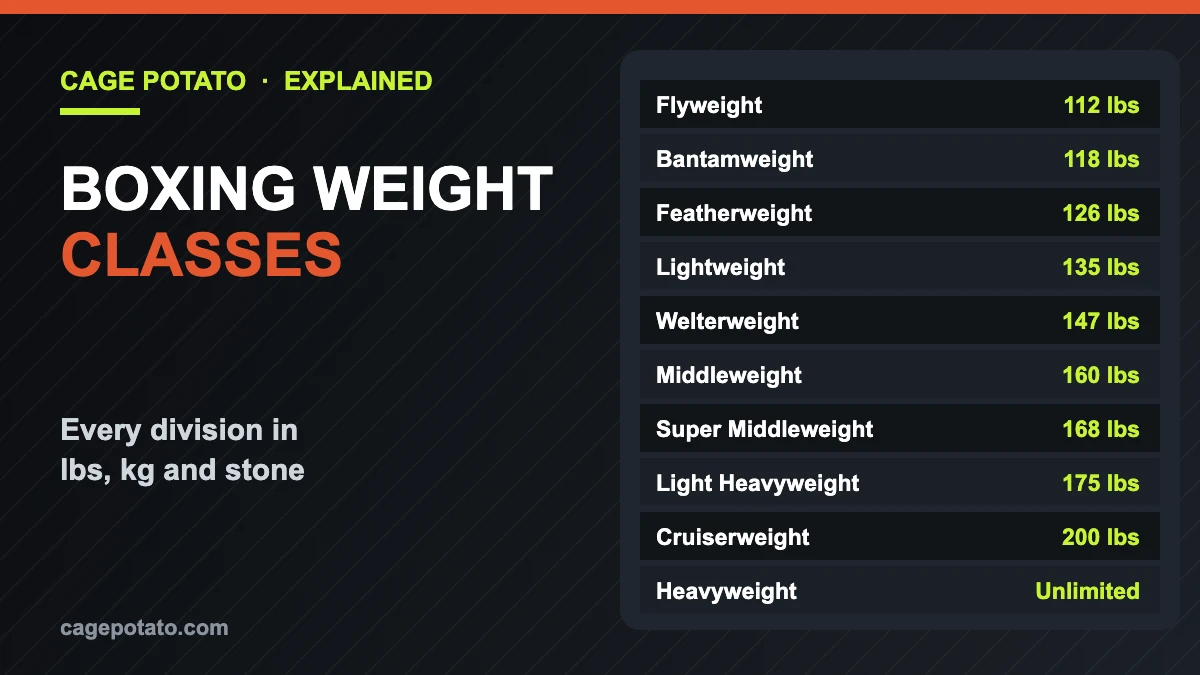
Boxing weight classes chart
| Weight class | Limit (lbs) | Limit (kg) | Limit (stone) | Also known as |
|---|---|---|---|---|
| Minimumweight | 105 lbs | 47.6 kg | 7 st 7 lb | Strawweight, mini flyweight |
| Light Flyweight | 108 lbs | 49.0 kg | 7 st 10 lb | Junior flyweight |
| Flyweight | 112 lbs | 50.8 kg | 8 st 0 lb | – |
| Super Flyweight | 115 lbs | 52.2 kg | 8 st 3 lb | Junior bantamweight |
| Bantamweight | 118 lbs | 53.5 kg | 8 st 6 lb | – |
| Super Bantamweight | 122 lbs | 55.3 kg | 8 st 10 lb | Junior featherweight |
| Featherweight | 126 lbs | 57.2 kg | 9 st 0 lb | – |
| Super Featherweight | 130 lbs | 59.0 kg | 9 st 4 lb | Junior lightweight |
| Lightweight | 135 lbs | 61.2 kg | 9 st 9 lb | – |
| Super Lightweight | 140 lbs | 63.5 kg | 10 st 0 lb | Junior welterweight |
| Welterweight | 147 lbs | 66.7 kg | 10 st 7 lb | – |
| Super Welterweight | 154 lbs | 69.9 kg | 11 st 0 lb | Junior middleweight, light middleweight |
| Middleweight | 160 lbs | 72.6 kg | 11 st 6 lb | – |
| Super Middleweight | 168 lbs | 76.2 kg | 12 st 0 lb | – |
| Light Heavyweight | 175 lbs | 79.4 kg | 12 st 7 lb | – |
| Cruiserweight | 200 lbs | 90.7 kg | 14 st 4 lb | Junior heavyweight |
| Bridgerweight (WBC only) | 224 lbs | 101.6 kg | 16 st 0 lb | – |
| Heavyweight | No upper limit | – | ||
The limits are the same across the WBC, WBA, IBF and WBO, but the names vary: one organisation’s “super lightweight” is another’s “junior welterweight”. The Ring magazine also recognises champions across the traditional divisions.
Boxing weight classes in stone
In the UK and Ireland, fighters’ weights are often quoted in stone. A few of the most common: lightweight is 9 st 9 lb, welterweight is 10 st 7 lb, middleweight is 11 st 6 lb, super middleweight is 12 st and light heavyweight is 12 st 7 lb. Cruiserweight is 14 st 4 lb, and anything above that is heavyweight.
The newest boxing weight classes
Bridgerweight (224 lbs) was created by the WBC in 2020 as a bridge between cruiserweight and heavyweight, for fighters too big for 200 lbs but giving up too much size to giant heavyweights. The WBA also adopted it in 2023, but in June 2026 it announced it would stop recognising the division, leaving the WBC as its main backer.
The cruiserweight limit itself has moved over the years. It began at 190 lbs in 1979 and was raised to 195 and then 200 lbs as heavyweights grew bigger.
How boxing weigh-ins work
Most professional title fights have the official weigh-in the day before the fight. Some sanctioning bodies also run fight-week checks to limit extreme rehydration: the IBF, for example, has held a second-day weigh-in on the morning of the fight, limiting how much weight a boxer can regain. A boxer who misses weight in a title fight is usually ineligible to win the belt and may be fined part of their purse.
Boxing vs MMA weight classes
Boxing has nearly twice as many divisions as the UFC, and the gaps are much smaller, usually three to seven pounds in the lighter divisions. Boxers can move up or down one division without major changes to their body, while MMA fighters often face a 10 to 15-pound jump. Also, boxing heavyweight has no upper limit, while MMA heavyweights must be 265 lbs or lighter.
Not sure where you would fit? Our weight class finder suggests a boxing or MMA division based on your walking weight.
Other combat sports weight classes
- UFC weight classes explained
- IBJJF weight classes
- BKFC weight classes
- ONE Championship weight classes
- UFC BJJ weight classes
- BKB weight classes
- Wrestling weight classes
Free fighter tools
- Weight class finder: find the MMA or boxing division that suits your walking weight.
- Weight cut calculator: check whether a cut is realistic and safe.
- Tale of the tape: compare two fighters’ height, reach and weight.
- Fighter calorie calculator: daily calories and protein for fight camp.
Boxing weight class FAQs
How many weight classes are there in boxing?
There are 17 traditional weight classes in professional boxing, from minimumweight (105 lbs) to heavyweight (no limit). The WBC also recognises an 18th, bridgerweight, at 224 lbs.
What is the heaviest weight class in boxing?
Heavyweight, which has no upper limit. Fighters must weigh over the cruiserweight limit of 200 lbs (or 224 lbs where bridgerweight is recognised).
What weight is middleweight in boxing?
The middleweight limit is 160 lbs, which is 72.6 kg or 11 st 6 lb.
What weight is welterweight in boxing in stone?
Boxing welterweight has a limit of 147 lbs, which is 10 st 7 lb or 66.7 kg.
What is the difference between super and junior weight classes?
Nothing. They are different names for the same divisions. For example, super lightweight and junior welterweight both have a 140-pound limit.
Is bridgerweight still a division?
The WBC still recognises bridgerweight (224 lbs). The WBA announced in June 2026 that it would stop sanctioning the division.