
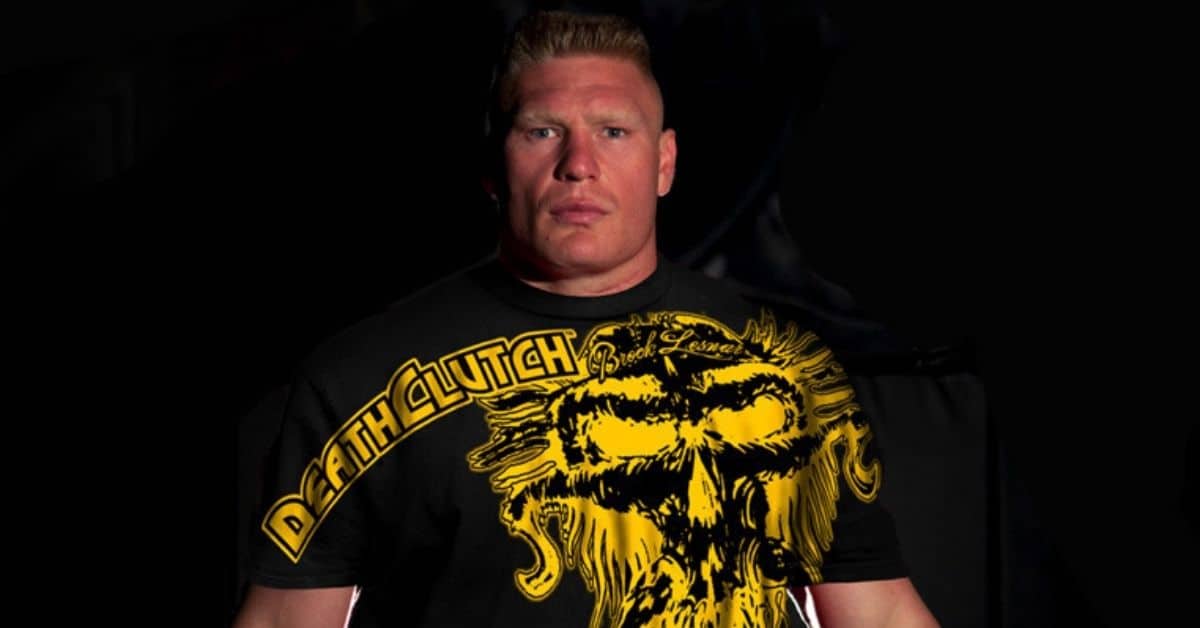
Exclusive Interview: Brock Lesnar Discusses ‘Death Clutch’, Part 2
For part one of our conversation with Brock Lesnar, click here.
BRIAN D’SOUZA: There’s your stage persona, and there’s your own job and family. I understand you didn’t want the media to cut into time when you’re having dinner with your family.
BROCK LESNAR: I really don’t know anybody that does. My time with family is very important to me and in today’s age with the cell phone and the internet, there’s not a lot of privacy left in this world and everybody knows what everyone is doing at any given time and I don’t really care if anyone knows what I’m doing at any given time.
Moving on to your wrestling career, you talk about not having watched — what is it — five minutes of wrestling before you came to professional wrestling. Is that true?
That is true.
So what sports were you drawn to view, to watch, growing up?
Well growing up, we had 2 ½ TV channels that sometimes worked, and sometimes didn’t. And in the summertime, I very rarely watched any television because we were working. I was outside. To me, if I’m inside, I don’t feel natural. My sons are the same way — they’d rather be outside doing something and I think that that’s a big problem in today’s society where kids are in front of the computer, the television and the game boxes; they don’t get to go outside and experience communication, and nature, and get out and be creative and entertain yourself, and not having to be entertained by technology.
That’s a very valid point. But kids today are seen as consumers and the companies want to sell as much product as they can to them, and if that means forcing them to stay in this circle where the media starts exploiting them from the start…
I’m sure, but I think that’s where parenting has to come in and do certain things, but I can only control what’s happening in my household, and that’s fine with me.
Back to wrestling, you talk about Vince McMahon putting his guys on the road 300 days a year, through injuries, and eventually he gets a little bit of ownership over the wrestlers, is that correct?
These guys, they just don’t have another life. When they go home, they really can’t get out of tune with their on-stage persona. There’s really no time. I think the biggest thing is there’s really no downtime for the human body to recover, and more importantly, for their mind to recover where you’re constantly on the road, and in a program where you can’t get outside to take an outside look at what’s going on — guys resort to all kinds of extracurricular activities.
And by those, we’re talking about painkillers — because the injuries are constant and lagging — a lot of exploits, a lot of good times, but a lot of meaningless relationships, too.
Everything in general, whether it’s all the above, I’m sure there’s all kinds of that going on.
What kind of regulations were in place to protect the safety of wrestlers, or even [let you know] if you were being paid fairly? Was there anything like that?
No, none whatsoever. We were hired as independent contractors, and there was no players’ or wrestlers’ union or anything like that for us to even be involved in. And I chose to leave that career; most guys are happy with that career, and that’s fine. As long as they’re happy with their life — and I wasn’t, so that’s why I decided to make the move.
Sometimes we do see a bit of exploitation when regulations are not in place. In boxing, there were a lot of problems with corruption. Boxing was once a monopoly in the ’50s, sort of controlled by mafia-type gangsters, and they could even tell you what the outcome of fights would be…the government eventually had to step in. Do you think there should be a couple more laws in place to protect wrestlers almost from themselves?
At the end of the day, listen, these are grown men and women you’re talking about, and if they’re not responsible enough to take care of themselves like I was, or was able to do, I can’t point a finger at Vince McMahon or his company because they’re running a business, and they run it on capitalism and it’s good for them, but if the wrestler, and the individual can’t take care of it, then find a different occupation like I did.
A couple quotes here about Vince McMahon, one that I thought was really good, “Vince has ended more than one career when someone crossed him and put their own [interests] above the company.” You know, that’s the pro wrestling model. Do you have anymore details about what the politics were, exactly?
Like I said before, working for that company, you have to be a yes-man. You couldn’t write your own storyline; you were pushed by the writing team and the power of the pencil. So, as long as you were a good student, and the company thought that they could make a good amount of money off of you, then the writer and the pencil got behind you, whereas in the UFC, I’m in control of my own destiny. It’s just me and the other man in there, and when I win, it’s on my terms, and it’s not because somebody behind the curtain said that “you’re winning tonight.”
You were criticized very heavily when you entered the UFC — very heavily and very unfairly when you look at your wrestling credentials — for getting the title shot after beating Heath Herring, and then fighting Randy Couture. How did that make you feel?
It didn’t bother me at all. I had something to prove, and that was to be UFC heavyweight champion at the time. It just fueled the fighter within me, and it made me want to prove everybody wrong even more.
With your illness that cropped up before your Shane Carwin fight…you said you came close to feeling like — or thinking — you were going to die. What revelations did you have?
Here I was, I thought I was a healthy person, and I was laying in a hospital room, unsure of what my sickness was. And in a lot of pain, so a lot of things go through your mind, wondering what’s going to happen, what does the future lie and what direction is this going to take you.
Come back tomorrow for the final installment of our interview with Brock Lesnar, plus audio of the entire interview.