
Martial Arts List A–Z: 64 Martial Arts and Fighting Styles Explained
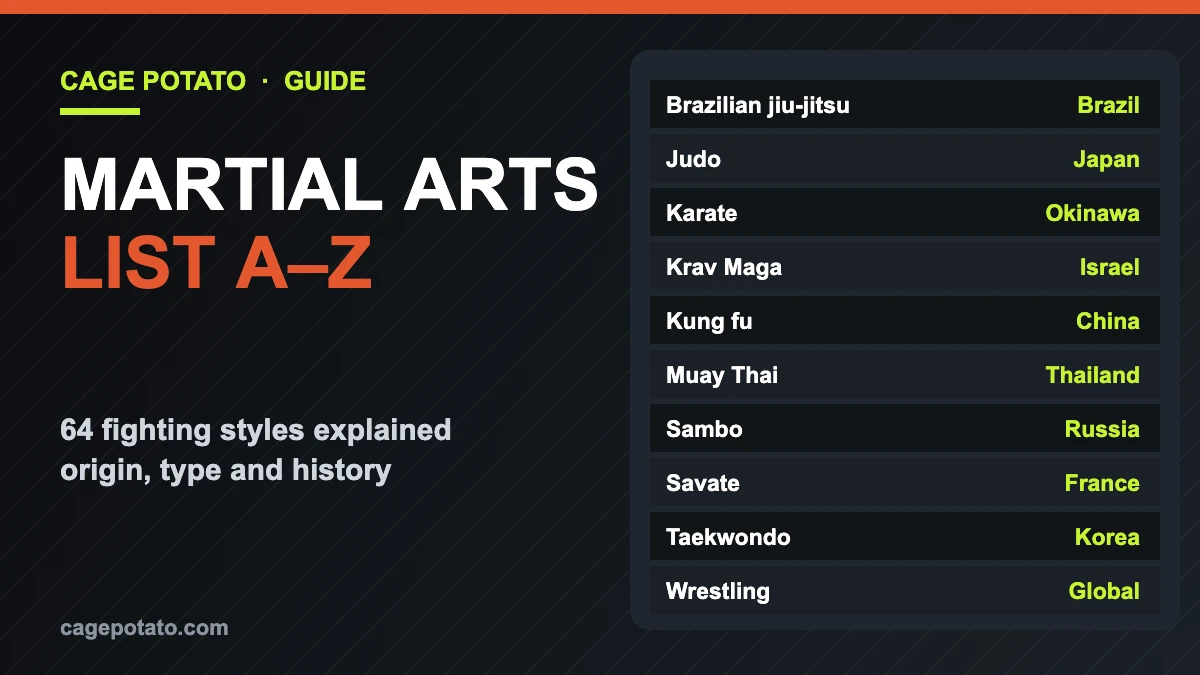
There are hundreds of martial arts around the world, from ancient battlefield systems to modern combat sports. This A–Z list covers 64 of the most important, with where each one comes from, whether it focuses on striking, grappling or weapons, and a one-line explanation of what makes it different.
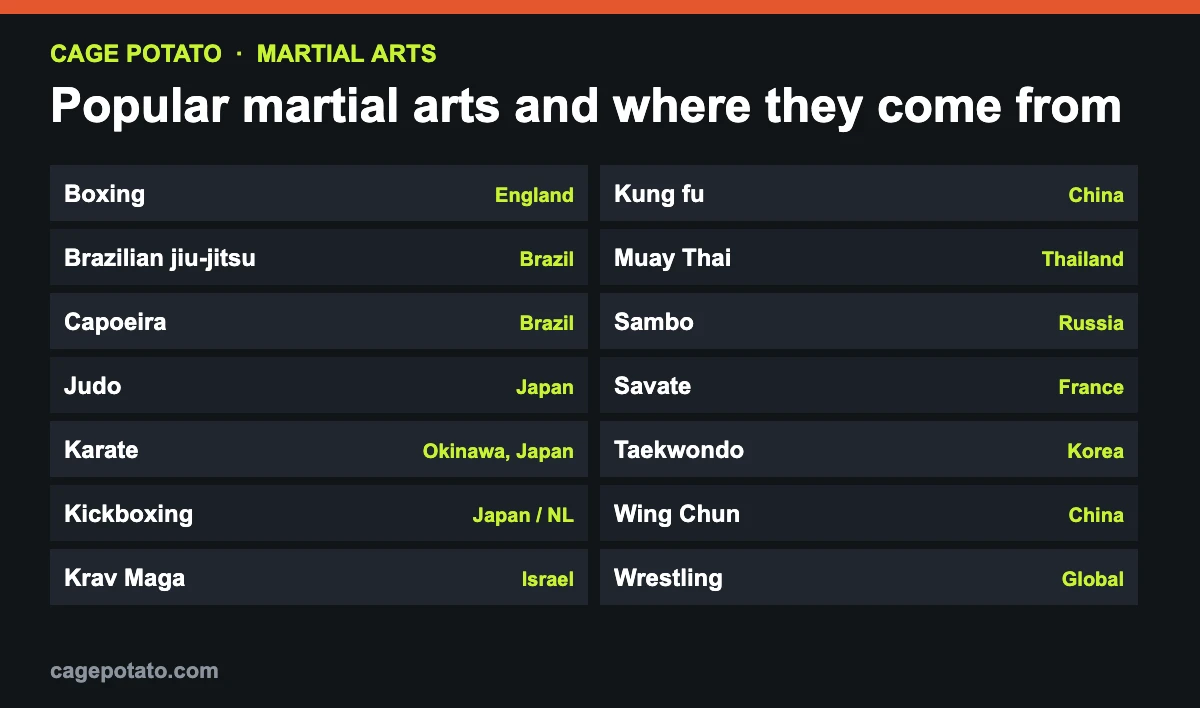
Martial arts list at a glance
| Martial art | Origin | Type |
|---|---|---|
| Aikido | Japan | Grappling |
| Arnis / Eskrima / Kali | Philippines | Weapons and striking |
| Bajiquan | China | Striking |
| Bando | Myanmar | Mixed |
| Bare-knuckle boxing | England | Striking |
| Bartitsu | England | Mixed |
| Bojutsu | Japan | Weapons |
| Bokator | Cambodia | Mixed |
| Boxing | Ancient Greece / England | Striking |
| Brazilian jiu-jitsu (BJJ) | Brazil | Grappling |
| Capoeira | Brazil | Striking |
| Catch wrestling | England / USA | Grappling |
| Chin Na | China | Grappling |
| Choi Kwang-Do | Korea | Striking |
| Combat Sambo | Russia | Mixed |
| Dambe | Nigeria | Striking |
| Eagle Claw | China | Striking and grappling |
| Fencing | Europe | Weapons |
| Glima | Iceland | Grappling |
| Gatka | India | Weapons |
| Hapkido | Korea | Mixed |
| Hung Ga | China | Striking |
| Iaido | Japan | Weapons |
| Jeet Kune Do | USA | Mixed |
| Jujutsu (Japanese) | Japan | Grappling |
| Judo | Japan | Grappling |
| Jukendo | Japan | Weapons |
| Kajukenbo | USA (Hawaii) | Mixed |
| Kalaripayattu | India | Mixed |
| Karate | Japan (Okinawa) | Striking |
| Kendo | Japan | Weapons |
| Kenpo / Kempo | Japan / USA | Striking |
| Kickboxing | Japan / Netherlands / USA | Striking |
| Krav Maga | Israel | Mixed |
| Kudo | Japan | Mixed |
| Kung fu (Wushu) | China | Mixed |
| Kurash | Uzbekistan | Grappling |
| Kyokushin | Japan | Striking |
| Lethwei | Myanmar | Striking |
| Luta Livre | Brazil | Grappling |
| Mixed martial arts (MMA) | Global | Mixed |
| Muay Boran | Thailand | Striking |
| Muay Thai | Thailand | Striking |
| Ninjutsu | Japan | Mixed |
| Pankration | Ancient Greece | Mixed |
| Pencak Silat | Indonesia / Malaysia | Mixed |
| Pradal Serey | Cambodia | Striking |
| Sambo | Russia | Grappling |
| Sanda (Sanshou) | China | Striking |
| Savate | France | Striking |
| Shootfighting | Japan | Mixed |
| Shorinji Kempo | Japan | Mixed |
| Shuai Jiao | China | Grappling |
| Silambam | India | Weapons |
| Sumo | Japan | Grappling |
| Systema | Russia | Mixed |
| Taekwondo | Korea | Striking |
| Tai chi | China | Mixed |
| Tang Soo Do | Korea | Striking |
| Wing Chun | China | Striking |
| Wrestling (freestyle and Greco-Roman) | Global | Grappling |
| Xing Yi Quan | China | Striking |
| Yaw-Yan | Philippines | Striking |
| Zui Quan (Drunken Boxing) | China | Striking |
A
- Aikido (Japan): Joint locks and throws that redirect an attacker’s momentum, founded by Morihei Ueshiba.
- Arnis / Eskrima / Kali (Philippines): Stick and blade fighting that also teaches empty-hand techniques.
B
- Bajiquan (China): Explosive, short-range kung fu style known for elbow and shoulder strikes.
- Bando (Myanmar): Traditional Burmese self-defence system with striking, grappling and weapons.
- Bare-knuckle boxing (England): Boxing without gloves; revived as a professional sport by BKFC and BKB.
- Bartitsu (England): Victorian-era self-defence combining jujutsu, boxing, savate and stick fighting.
- Bojutsu (Japan): The art of the bo, a long wooden staff.
- Bokator (Cambodia): Ancient Khmer battlefield art with strikes, locks and weapons.
- Boxing (Ancient Greece / England): Punches only, with gloves; an Olympic sport and the base of most MMA striking.
- Brazilian jiu-jitsu (BJJ) (Brazil): Ground fighting and submissions developed by the Gracie family; essential in MMA.
C
- Capoeira (Brazil): Acrobatic Afro-Brazilian art that blends kicks, music and dance.
- Catch wrestling (England / USA): Submission wrestling that influenced early pro wrestling and modern MMA.
- Chin Na (China): Kung fu joint-locking and pressure techniques.
- Choi Kwang-Do (Korea): Modern self-defence art built around fluid, non-locking strikes.
- Combat Sambo (Russia): Military form of sambo with strikes, throws and submissions.
D
- Dambe (Nigeria): Hausa boxing where the strong hand is wrapped as a striking weapon.
E
- Eagle Claw (China): Kung fu style known for gripping, joint locks and pressure-point strikes.
F
- Fencing (Europe): Olympic sword sport using foil, épée and sabre.
G
- Glima (Iceland): Viking-era wrestling with a distinctive belt grip.
- Gatka (India): Sikh martial art using sticks and swords.
H
- Hapkido (Korea): Joint locks, throws and kicks with an emphasis on circular movement.
- Hung Ga (China): Southern kung fu style known for low stances and powerful hand techniques.
I
- Iaido (Japan): The art of drawing and cutting with the Japanese sword.
J
- Jeet Kune Do (USA): Bruce Lee’s philosophy of using what works, a forerunner of MMA thinking.
- Jujutsu (Japanese) (Japan): Samurai unarmed combat that gave rise to judo and Brazilian jiu-jitsu.
- Judo (Japan): Throws and pins developed by Jigoro Kano; an Olympic sport.
- Jukendo (Japan): Bayonet fighting practised as a sport.
K
- Kajukenbo (USA (Hawaii)): Blend of karate, judo, jujutsu, kenpo and Chinese boxing.
- Kalaripayattu (India): One of the oldest martial arts, with kicks, strikes, weapons and healing techniques.
- Karate (Japan (Okinawa)): Punches, kicks and kata; styles include Shotokan, Kyokushin and Goju-ryu.
- Kendo (Japan): Sport fencing with bamboo swords and armour.
- Kenpo / Kempo (Japan / USA): Fast hand combinations; American Kenpo was developed by Ed Parker.
- Kickboxing (Japan / Netherlands / USA): Punches and kicks in a ring; Dutch kickboxing is a staple of MMA striking.
- Krav Maga (Israel): Practical self-defence system developed for the Israel Defense Forces.
- Kudo (Japan): Full-contact art with headgear that allows strikes and grappling.
- Kung fu (Wushu) (China): Umbrella term for hundreds of Chinese styles; wushu is the modern sport form.
- Kurash (Uzbekistan): Traditional jacket wrestling, now an international sport.
- Kyokushin (Japan): Full-contact karate founded by Masutatsu Oyama, famous for knockdown fighting.
L
- Lethwei (Myanmar): Burmese boxing that allows headbutts, traditionally fought bare-knuckle.
- Luta Livre (Brazil): Brazilian no-gi submission wrestling, historic rival of BJJ.
M
- Mixed martial arts (MMA) (Global): Combines striking and grappling under unified rules; the sport of the UFC.
- Muay Boran (Thailand): The traditional ancestor of Muay Thai.
- Muay Thai (Thailand): The “art of eight limbs”: punches, kicks, knees, elbows and the clinch.
N
- Ninjutsu (Japan): The skills attributed to the ninja, practised today in schools such as Bujinkan.
P
- Pankration (Ancient Greece): Ancient Olympic event mixing boxing and wrestling; often called the first MMA.
- Pencak Silat (Indonesia / Malaysia): Family of Southeast Asian arts with strikes, sweeps, locks and weapons.
- Pradal Serey (Cambodia): Khmer kickboxing similar to Muay Thai, with elbows and knees.
S
- Sambo (Russia): Soviet-developed jacket wrestling with leg locks; Khabib Nurmagomedov’s base.
- Sanda (Sanshou) (China): Chinese kickboxing that also allows throws.
- Savate (France): French kickboxing performed in shoes.
- Shootfighting (Japan): Professional MMA-style rules from 1980s–90s Japan, linked to Shooto.
- Shorinji Kempo (Japan): Self-defence art with strikes and joint locks, founded in 1947.
- Shuai Jiao (China): One of the oldest forms of Chinese wrestling, focused on throws.
- Silambam (India): Tamil staff-fighting art.
- Sumo (Japan): Push a rival out of the ring or make him touch the ground with anything but his feet.
- Systema (Russia): Russian art emphasising breathing, relaxation and fluid movement.
T
- Taekwondo (Korea): Kick-focused Olympic sport with spinning and jumping techniques.
- Tai chi (China): Slow-movement internal art practised for health and as self-defence.
- Tang Soo Do (Korea): Korean art related to karate, with kicks, forms and sparring.
W
- Wing Chun (China): Close-range kung fu taught to Bruce Lee by Ip Man.
- Wrestling (freestyle and Greco-Roman) (Global): Olympic takedown sport and the most successful base in MMA history.
X
- Xing Yi Quan (China): Internal kung fu style built on direct, linear power.
Y
- Yaw-Yan (Philippines): Filipino kickboxing known for downward-cutting kicks.
Z
- Zui Quan (Drunken Boxing) (China): Kung fu style that imitates a drunk’s unpredictable movement.
Which martial arts are best for MMA?
Most successful MMA fighters build their game on a few core arts: wrestling for takedowns and control, Brazilian jiu-jitsu for submissions, and Muay Thai, kickboxing or boxing for striking. Sambo, judo and karate have also produced champions. If you are starting out, our weight class finder and fighter calorie calculator are good next stops.
Related guides
- Karate belt order
- How to tie a karate belt
- IBJJF weight classes
- Wrestling weight classes
- UFC weight classes
Martial arts FAQs
How many martial arts are there?
There is no official count, but there are several hundred distinct martial arts and styles worldwide. Chinese kung fu alone includes hundreds of styles.
What is the oldest martial art?
Kalaripayattu from India and wrestling are often cited among the oldest. Wrestling appears in ancient art thousands of years old, and pankration was part of the ancient Olympic Games.
What is the most effective martial art for self-defence?
There is no single answer, but arts with live sparring against resisting partners, such as boxing, Muay Thai, wrestling, judo and Brazilian jiu-jitsu, tend to translate best to real situations.
What is the difference between striking and grappling martial arts?
Striking arts such as boxing, karate and Muay Thai use punches, kicks, knees and elbows. Grappling arts such as wrestling, judo and BJJ use takedowns, throws, pins and submissions.
What martial art did Bruce Lee practise?
Bruce Lee trained in Wing Chun under Ip Man and later created his own philosophy, Jeet Kune Do.