
Every MMA and BJJ Submission Explained: Chokes, Arm Locks and Leg Locks
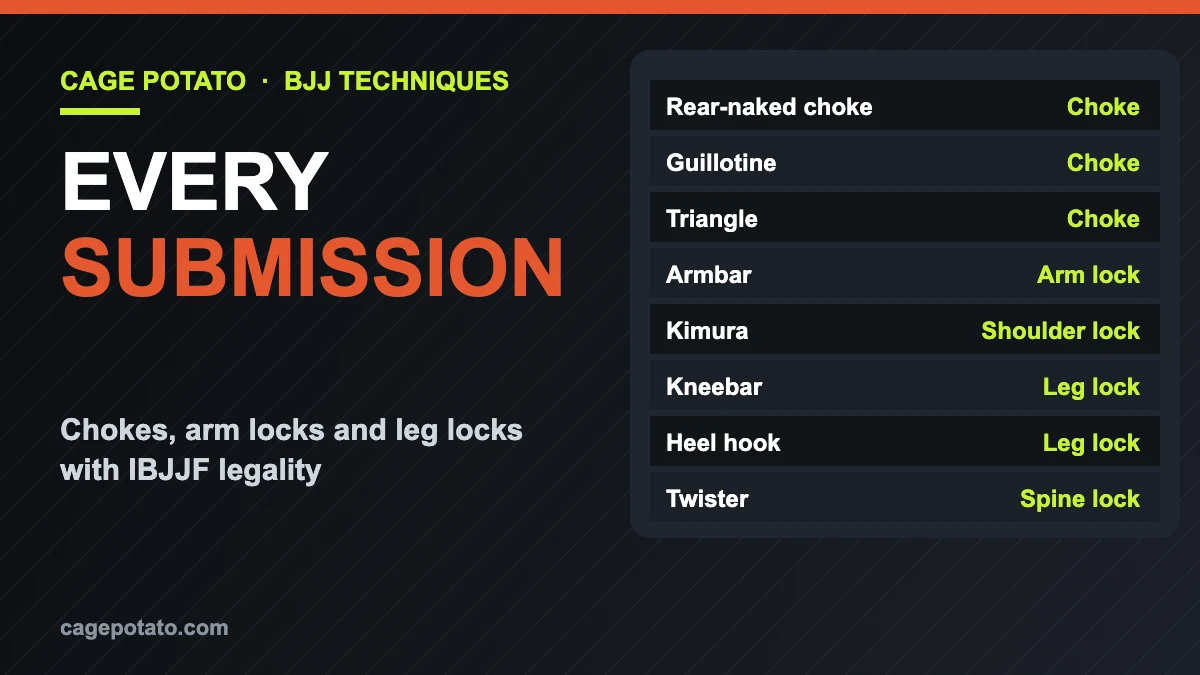
Submissions are how grapplers win without strikes. This hub covers every major MMA and BJJ submission, grouped by type, with the position it comes from and whether it is allowed in IBJJF jiu-jitsu. Click through for step-by-step guides, defences and famous UFC finishes. All of these are legal in MMA under the Unified Rules except where noted.
Chokes (strangles)
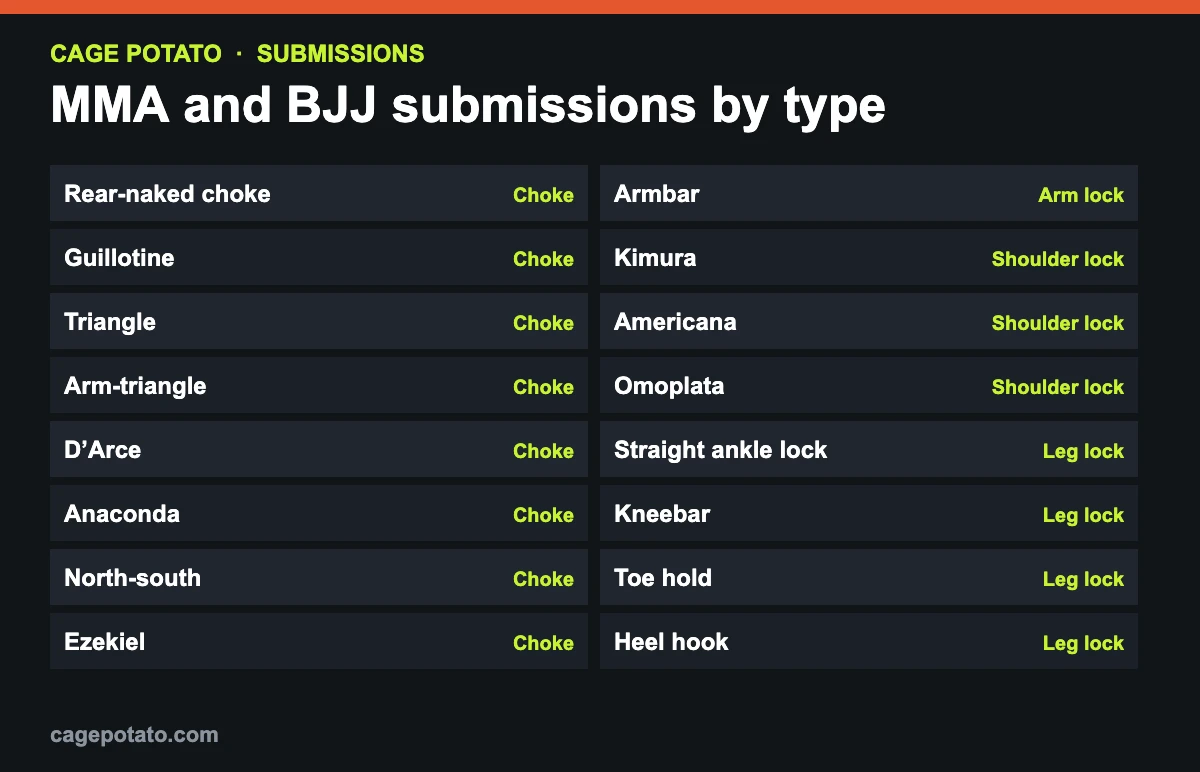
| Submission | Main position | IBJJF (adult) |
|---|---|---|
| Rear-naked choke | Back control | All adult belts |
| Guillotine choke | Front headlock, guard | All adult belts |
| Triangle choke | Guard | All adult belts |
| Arm-triangle choke | Mount, side control | All adult belts |
| D’Arce choke | Front headlock, turtle | All adult belts |
| Anaconda choke | Front headlock, turtle | All adult belts |
| North-south choke | North-south | All adult belts |
| Ezekiel choke | Mount, inside guard | All adult belts |
| Bow and arrow choke (gi) | Back control | All adult belts |
| Cross collar choke (gi) | Guard, mount | All adult belts |
| Gogoplata | Rubber guard | Check current rules |
| Von Flue choke | Top of guillotine | All adult belts |
Arm locks and shoulder locks
| Submission | Main position | IBJJF (adult) |
|---|---|---|
| Armbar | Guard, mount, back | All adult belts |
| Kimura | Guard, side control | All adult belts |
| Americana | Mount, side control | All adult belts |
| Omoplata | Guard | All adult belts |
| Wrist lock | Many positions | Blue belt and above |
| Bicep slicer | Guard, side control | Brown and black only |
Leg locks
| Submission | Main position | IBJJF (adult) |
|---|---|---|
| Straight ankle lock | Ashi garami | All adult belts |
| Kneebar | Leg entanglement | Brown and black only |
| Toe hold | Leg entanglement | Brown and black only |
| Calf slicer | Back, truck | Brown and black only |
| Heel hook | Saddle, 50/50 | No-gi brown and black only |
Spine locks and neck cranks
| Submission | Main position | IBJJF (adult) |
|---|---|---|
| Twister | Back, truck | Not allowed |
| Can opener | Closed guard (top) | Not allowed |
| Neck crank | Various | Not allowed |
Neck cranks and spine locks such as the twister are banned in IBJJF competition but legal in MMA, where Chan Sung Jung (“The Korean Zombie”) famously finished Leonard Garcia with a twister at UFC Fight Night 24 in 2011.
Chokes vs joint locks
Chokes cut off blood flow (blood chokes such as the rear-naked choke) or air (air chokes such as some Ezekiel variations). Joint locks bend or twist a joint past its range of motion: arm locks attack the elbow, shoulder locks attack the shoulder and leg locks attack the knee or ankle. In MMA, chokes produce more finishes because they work even when a fighter is sweaty and hard to grip.
Which submissions are most common in the UFC?
The rear-naked choke is the most common submission in UFC history by a distance, followed by the guillotine, arm-triangle, armbar and triangle choke. Leg locks have become more common as no-gi grappling has influenced MMA.
Related guides
Submission FAQs
What is the most common submission in MMA?
The rear-naked choke is the most common submission finish in MMA and in UFC history.
What submissions are illegal in IBJJF?
Spine locks and neck cranks, such as the twister and can opener, are illegal at every level. Heel hooks are only allowed in no-gi at brown and black belt; kneebars, toe holds, calf slicers and bicep slicers only at brown and black belt; and wrist locks are not allowed for adult white belts.
What is the difference between a blood choke and an air choke?
A blood choke compresses the carotid arteries and can cause unconsciousness in seconds. An air choke compresses the windpipe and is usually slower and more painful.
What is the safest submission to learn first?
Most coaches start beginners with the armbar from guard and the rear-naked choke because they teach control and position.