
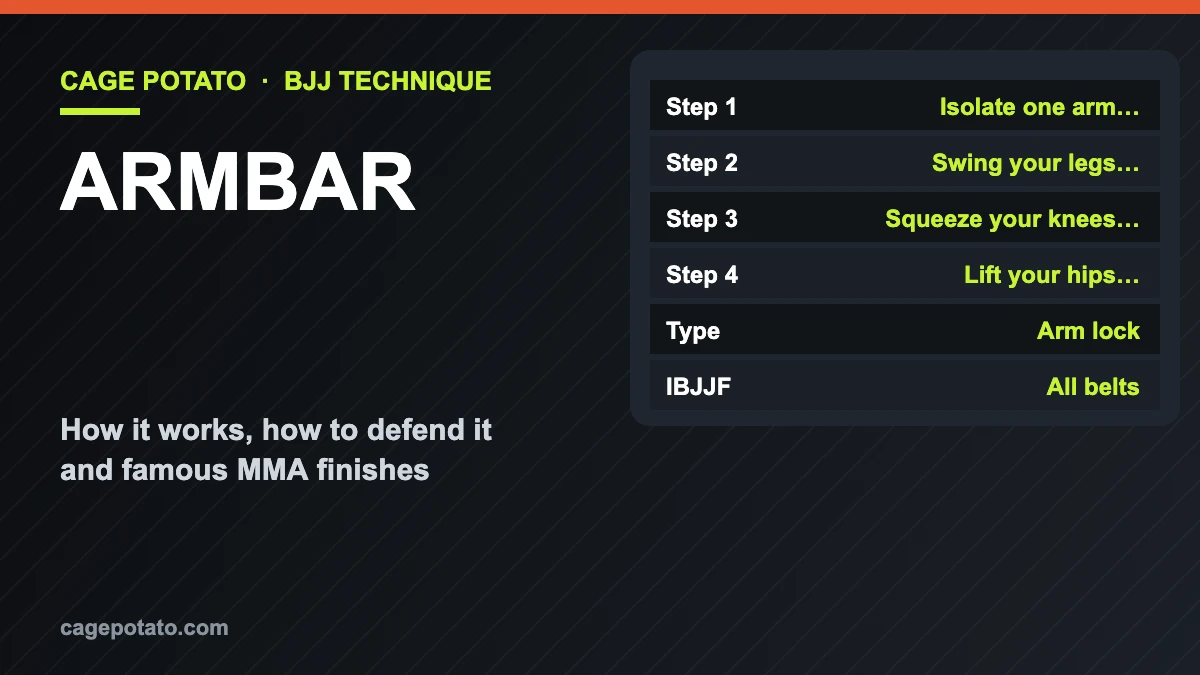
Armbar: How It Works, How to Defend It and Famous MMA Finishes
The armbar hyperextends the elbow joint. You isolate the opponent’s arm between your legs, pin it to your chest with the thumb pointing up, and lift your hips so the elbow bends the wrong way. It is a staple of judo, BJJ and MMA and one of the first submissions most students learn.
| Type | Arm lock |
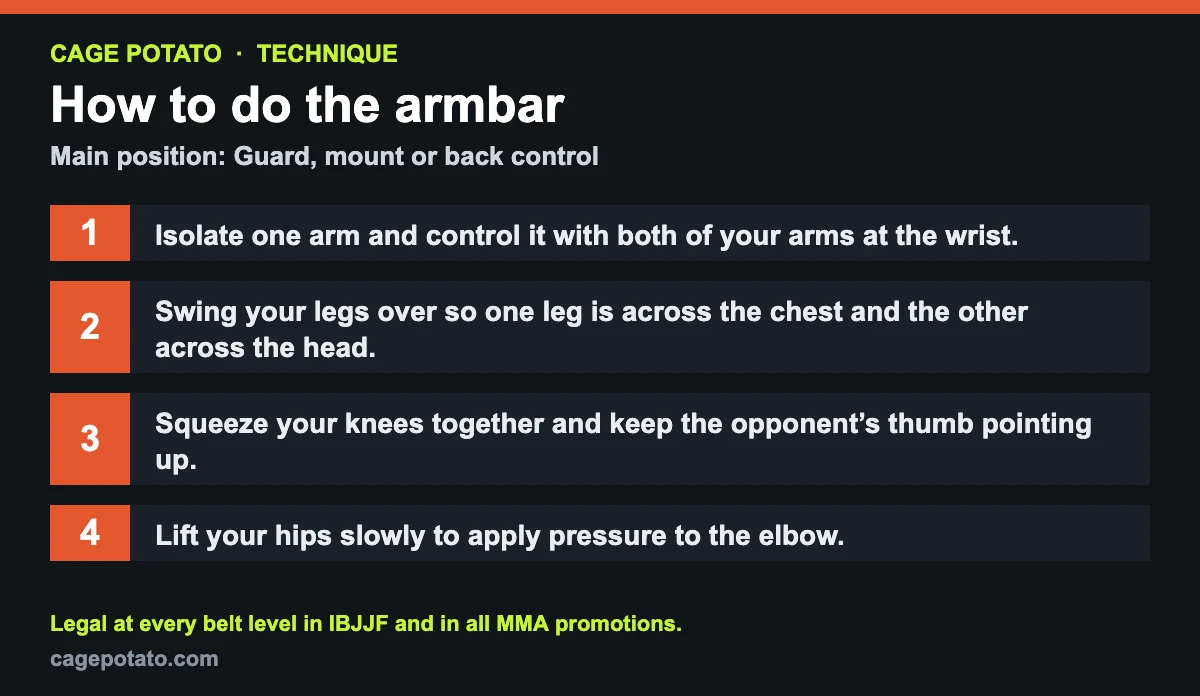
| Main positions | Guard, mount or back control |
| Also known as | Juji-gatame, straight armlock |
| Legality | Legal at every belt level in IBJJF and in all MMA promotions. |
How to do the armbar
- Isolate one arm and control it with both of your arms at the wrist.
- Swing your legs over so one leg is across the chest and the other across the head.
- Squeeze your knees together and keep the opponent’s thumb pointing up.
- Lift your hips slowly to apply pressure to the elbow.
Always learn submissions under a qualified coach and release the hold as soon as your partner taps.
How to defend the armbar
- Keep your elbows tight to your body and hands connected.
- Stack the opponent by driving your weight forward over their head.
- Turn your thumb down and pull the elbow out towards the opponent’s legs as you escape.
Famous armbar finishes
Ronda Rousey won almost all of her early professional fights by armbar, most of them in the first round, and became the most famous armbar specialist in MMA history.
More submissions
See our guide to all MMA and BJJ submissions, or read about the Rear-Naked Choke, Guillotine Choke, Triangle Choke, Kimura.
Armbar FAQs
What is a armbar?
The armbar hyperextends the elbow joint. You isolate the opponent’s arm between your legs, pin it to your chest with the thumb pointing up, and lift your hips so the elbow bends the wrong way.
Is the armbar legal in BJJ and MMA?
Legal at every belt level in IBJJF and in all MMA promotions.
What position is the armbar done from?
The armbar is mainly done from guard, mount or back control.