
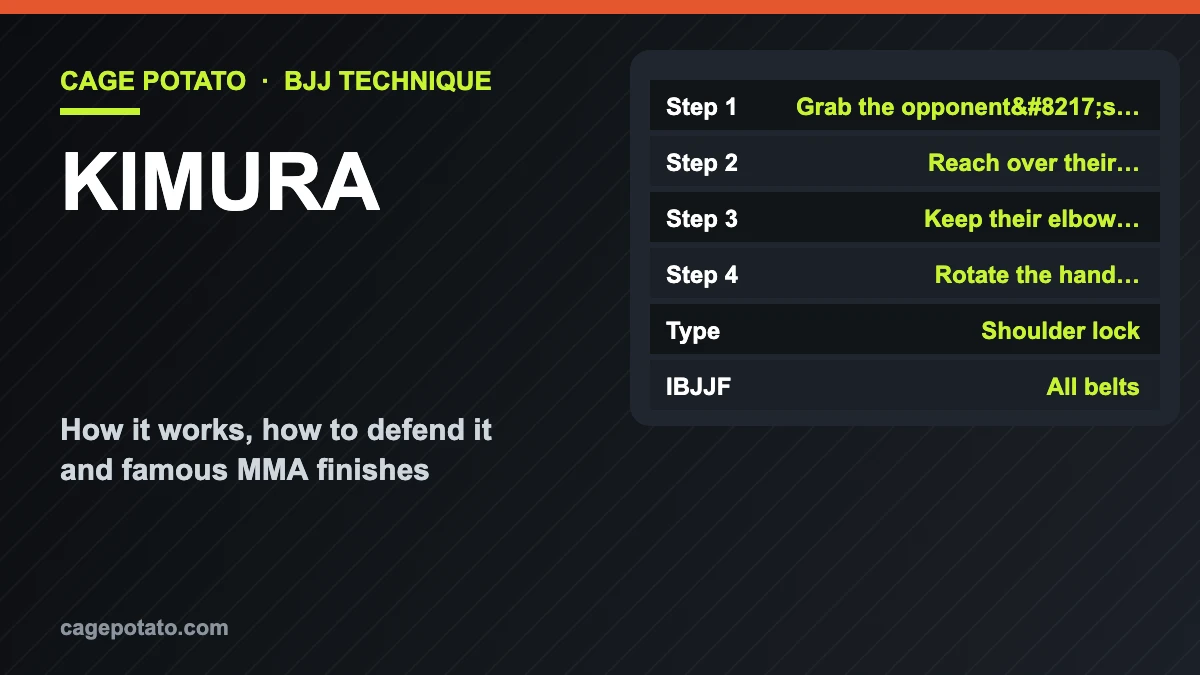
Kimura: How It Works, How to Defend It and Famous MMA Finishes
The kimura is a shoulder lock that twists the opponent’s arm behind their back. It is named after Japanese judoka Masahiko Kimura, who broke Hélio Gracie’s arm with it in their famous 1951 match in Brazil. As well as a submission, it is a powerful grip for sweeps and back takes.
| Type | Shoulder lock |
| Main positions | Guard, side control, north-south, standing |
| Also known as | Double wrist lock, ude-garami, gyaku ude-garami |
| Legality | Legal at every belt level in IBJJF and in all MMA promotions. |
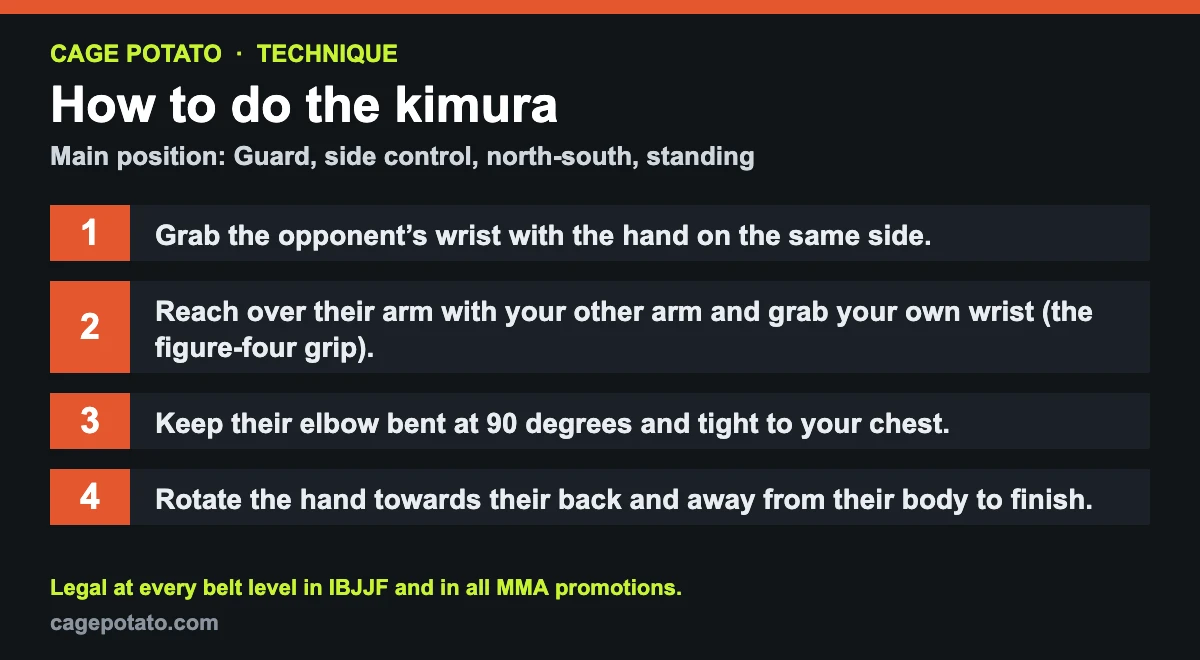
How to do the kimura
- Grab the opponent’s wrist with the hand on the same side.
- Reach over their arm with your other arm and grab your own wrist (the figure-four grip).
- Keep their elbow bent at 90 degrees and tight to your chest.
- Rotate the hand towards their back and away from their body to finish.
Always learn submissions under a qualified coach and release the hold as soon as your partner taps.
How to defend the kimura
- Grab your own belt, shorts or leg to keep the arm straight and stop the rotation.
- Keep your elbow tight to your ribs.
- Roll in the direction of the lock to relieve the pressure if caught.
Famous kimura finishes
Frank Mir broke Antonio Rodrigo Nogueira’s arm with a kimura at UFC 140 in 2011, making Mir the first person to submit Nogueira in MMA.
More submissions
See our guide to all MMA and BJJ submissions, or read about the Rear-Naked Choke, Guillotine Choke, Triangle Choke, Armbar.
Kimura FAQs
What is a kimura?
The kimura is a shoulder lock that twists the opponent’s arm behind their back. It is named after Japanese judoka Masahiko Kimura, who broke Hélio Gracie’s arm with it in their famous 1951 match in Brazil.
Is the kimura legal in BJJ and MMA?
Legal at every belt level in IBJJF and in all MMA promotions.
What position is the kimura done from?
The kimura is mainly done from guard, side control, north-south, standing.