

What Is Brazilian Jiu-Jitsu? History, Techniques, Belts and MMA
Brazilian jiu-jitsu (BJJ) is a grappling martial art built around taking an opponent to the ground, controlling them and finishing with a submission such as a choke or joint lock. Its core idea is that technique and leverage let a smaller person beat a bigger, stronger one.
| Origin | Brazil (from Japanese judo and jujutsu) |
| Type | Grappling |
| Famous MMA fighters | Royce Gracie, Demian Maia, Charles Oliveira, Fabricio Werdum, Brian Ortega |
History of Brazilian Jiu-Jitsu
BJJ began when Japanese judoka Mitsuyo Maeda settled in Belém, Brazil, and taught Carlos Gracie around 1917. Carlos and his brothers, especially Hélio, adapted the art to focus on ground fighting. The Gracies proved it in challenge matches for decades, and Royce Gracie’s wins at the early UFC events in 1993 and 1994 made BJJ essential for every MMA fighter. Read the full story in our Gracie family tree.
Key techniques
- Guard: fighting from your back with your legs as a weapon.
- Passing the guard to reach side control, mount or the back.
- Sweeps that reverse position from bottom to top.
- Submissions, including the rear-naked choke, armbar, triangle and kimura.
Brazilian Jiu-Jitsu belts and ranks
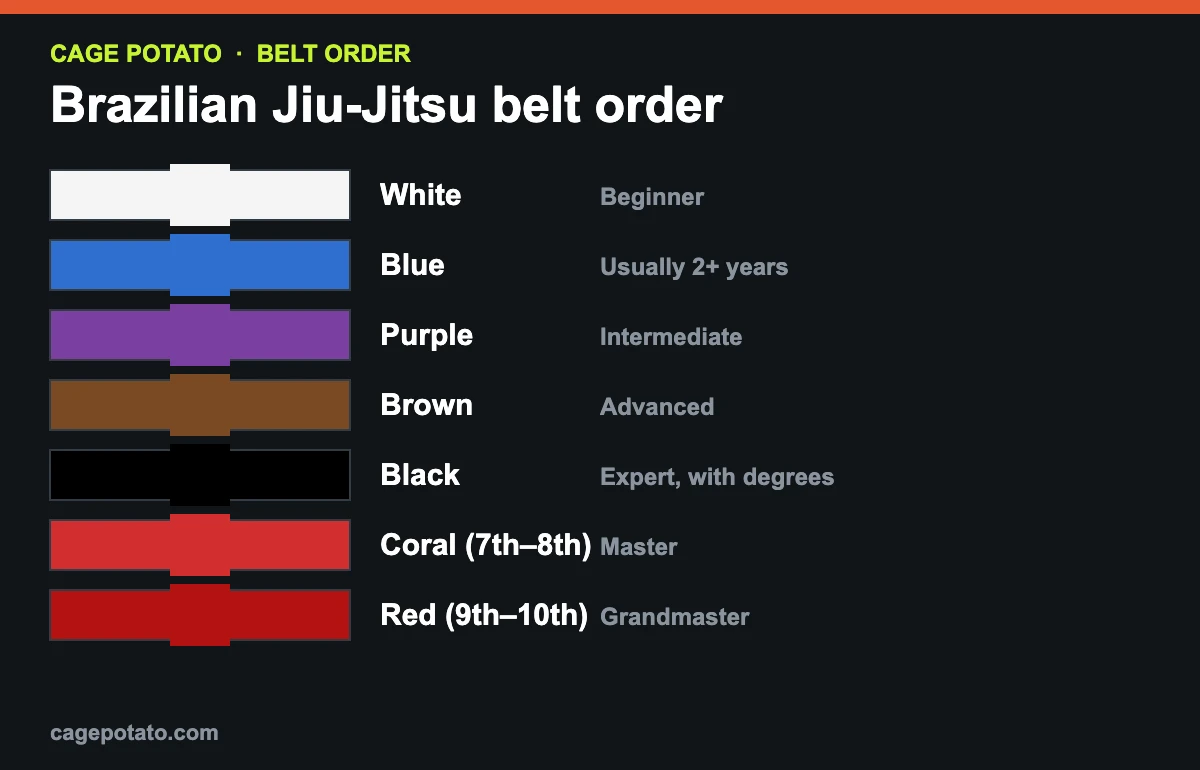
Adult BJJ belts go white, blue, purple, brown and black, with stripes on each belt. Above black are the coral belts (red-and-black for 7th degree, red-and-white for 8th) and red belt for 9th and 10th degree. A black belt typically takes around 8 to 12 years. Children have a separate system (grey, yellow, orange and green).
Brazilian Jiu-Jitsu in MMA
Almost every MMA fighter trains BJJ. Royce Gracie, Demian Maia, Charles Oliveira and Fabricio Werdum are among the best-known BJJ specialists in UFC history.
Other martial arts
Explore more styles in our martial arts list A–Z, or read about Muay Thai, Karate, Judo, Sambo.
Brazilian Jiu-Jitsu FAQs
How long does it take to get a BJJ black belt?
Most people take around 8 to 12 years of consistent training to earn a BJJ black belt.
What is the difference between BJJ and judo?
Judo focuses on throws and quick pins in competition, while BJJ focuses on ground control and submissions, with fewer restrictions on groundwork.
Is BJJ good for self-defence?
Yes. BJJ teaches you to control and submit a resisting opponent, which is why it became central to MMA.
What is gi and no-gi BJJ?
Gi BJJ is practised in a heavy jacket and trousers that can be gripped; no-gi is practised in shorts and a rash guard, which changes grips and techniques.