
What Is Wing Chun? History, Techniques, Ranks and MMA
Wing Chun is a southern Chinese kung fu style built for close-range fighting. It focuses on protecting the centreline, rapid straight punches, simultaneous blocking and striking, and sensitivity drills called chi sau (sticky hands).
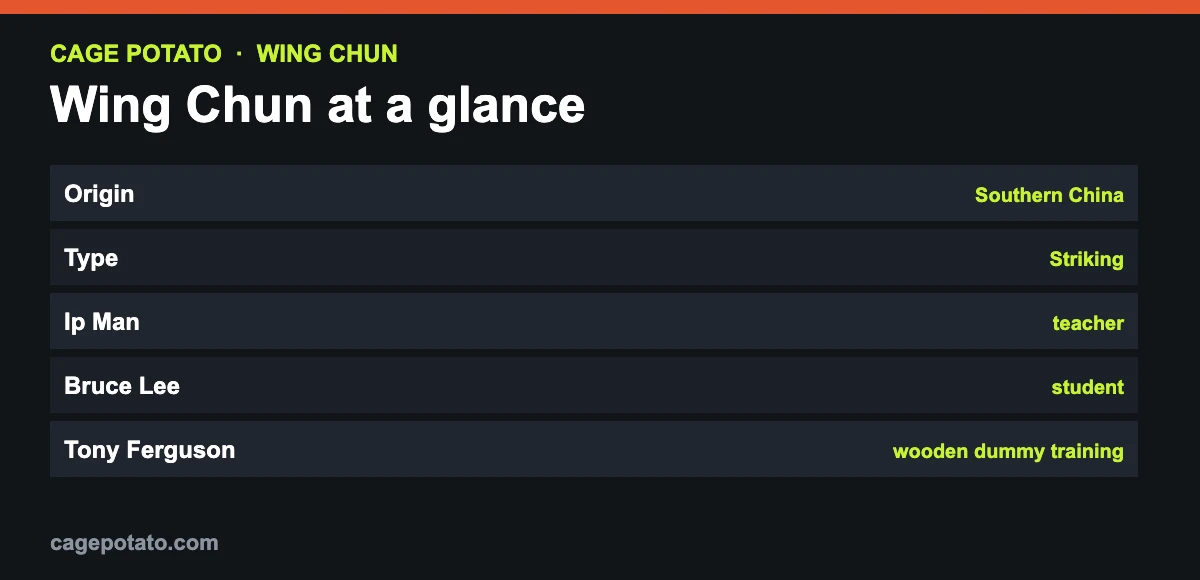
| Origin | Southern China |
| Type | Striking (close range) |
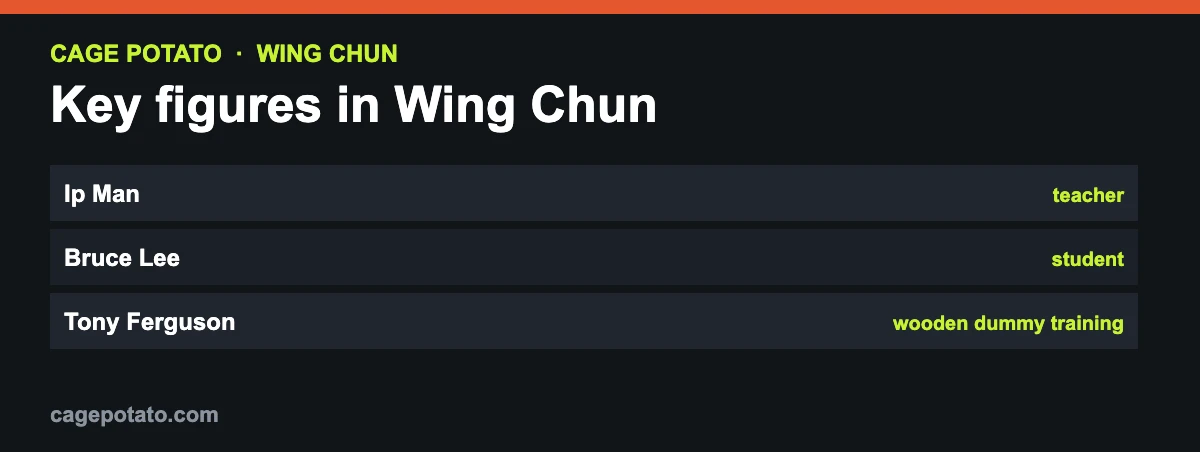
| Key figures | Ip Man (teacher), Bruce Lee (student), Tony Ferguson (wooden dummy training) |
History of Wing Chun
According to legend, Wing Chun was created by the Buddhist nun Ng Mui and named after her student Yim Wing-chun. It became famous through Ip Man, who taught it in Hong Kong from the 1950s. His most famous student, Bruce Lee, used Wing Chun as the foundation of his own approach, Jeet Kune Do.
Key techniques
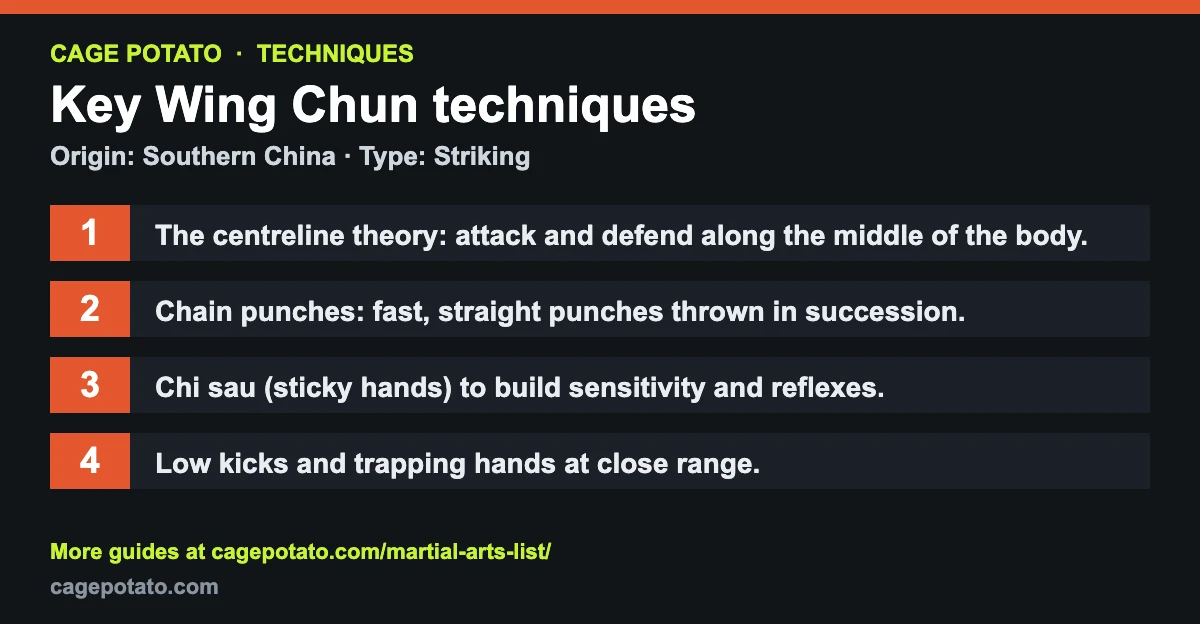
- The centreline theory: attack and defend along the middle of the body.
- Chain punches: fast, straight punches thrown in succession.
- Chi sau (sticky hands) to build sensitivity and reflexes.
- Low kicks and trapping hands at close range.
Wing Chun ranks
Many Wing Chun schools do not use belts and grade students by the forms they have learned: Siu Nim Tao, Chum Kiu, Biu Jee, then the wooden dummy (Muk Yan Jong) and weapons. Some schools use sashes or levels.
Wing Chun in MMA
Wing Chun is rarely a main base in MMA, but elements such as trapping and straight punches appear in some fighters’ games, and Tony Ferguson is known for training on a Wing Chun wooden dummy.
Other martial arts
Explore more styles in our martial arts list A–Z, or read about Brazilian Jiu-Jitsu, Muay Thai, Karate, Judo, Sambo.
Wing Chun FAQs
Who made Wing Chun famous?
Ip Man, who taught in Hong Kong from the 1950s, and his student Bruce Lee made Wing Chun famous worldwide.
What is chi sau?
Chi sau, or sticky hands, is a Wing Chun drill where partners keep their arms in contact to develop sensitivity and reflexes.
Does Wing Chun have belts?
Most traditional schools grade by forms rather than belts, though some modern schools use sashes or levels.
Is Wing Chun effective in MMA?
Wing Chun lacks takedown defence and ground fighting, so it is rarely used alone in MMA, although some of its striking ideas appear in fighters’ styles.